
Buddhist Monk with Supernatural Powers is a part of the chapter from my E-Book: Buddhist Monk Saved by Jesus. You can download it for free on my Home page ⟶ Buddhist Monk Saved by Jesus.
First Encounter with the Teacher
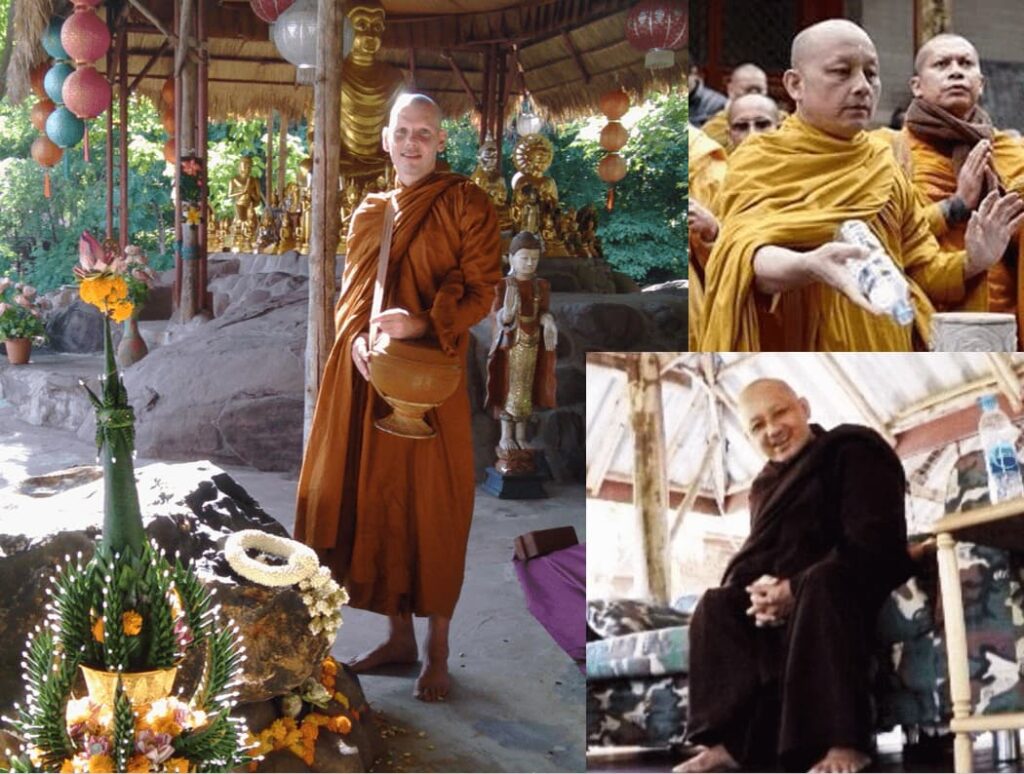
I set out to Nong Hin towards a Buddhist monk with supernatural powers. Shortly before arriving, a Thai monk boarded the bus. He told me his name was Sithipon and that he lived in Rombodhidharma. We took a three-wheeled taxi, called a tuk-tuk. We drove along a wide asphalt road, which was unusual for a forest monastery. We stopped in front of a large house next to an open space filled with many Buddha statues. Ahead, I could see a lake, a parking area, and many houses around it; it didn’t look like a typical monastery. It looked more like a village or a small, beautifully arranged settlement.
He told me that we will go first to greet the teacher and then I would see where I could stay. The large house at the entrance belonged to the main teacher. We entered a bright room with large windows. The teacher sat on a throne with Buddha statues behind him. On the floor beside him, visitors dressed in white sat on both sides. On the far right were two younger Thai monks. We knelt before him and bowed three times, as is customary.
Right away, I noticed that the teacher seemed very unusual in both appearance and voice, just like a Buddhist monk with supernatural powers. He asked about me, and one of the guests briefly translated what I said. Then the teacher and I looked each other in the eyes. I could see that he was pleased and nodded, satisfied with what he saw in the spirit. Before leaving, we bowed again, and as I touched the floor with my forehead during the second bow, I felt a very strong energy of emptiness in my mind. I looked at him with a smile and realized that it was he who had done that.
Meeting Other Monks, Nuns and Lay People
I was accommodated in a very large and beautiful wooden house where six tents were set up inside a big room. In the evening, I sat for a short meditation in the open hall. Later, I went for a walk along the road; there was a very peaceful and good energy throughout the place. Already on the first day, I saw that this place and this Buddhist monk with supernatural powers were more special than any I had encountered before. I met Ben from Singapore, a monk of the Zen tradition, which I had never seen before in Thailand. In the evening, he took me past some very beautiful houses to a terrace in front of the international house, where mostly Westerners gathered. There I met monk Jim from Russia, nun Maya and her friend Ana from England. Thai nuns Sasi and Ning spoke very good English and were responsible for translating the teacher’s teachings into English.
They talked and laughed. Sasi briefly explained the different way of teaching and living in this monastery compared to the Theravada tradition. A nun could teach monks; they could eat in the evening, and there was no meditation — which seemed strange to me. I saw the uniqueness of this teacher, yet all of this was in contrast to the traditional practice of renunciation and meditation.
The next day, Ajahn Visit brought me a message from the teacher, saying that I didn’t have to go on alms rounds into the town, because food was prepared for everyone in the monastery, and that I should listen to his teachings. Considering there were nearly a thousand people in this place and the teacher had remembered me, it gave me extra motivation to stay. Ajahn Visit was in charge of the house where I lived; he recorded the teacher’s talks, transferred them to CDs, and sent them around. He told me that this teacher was the best he knew and that I should listen to him and put aside all other teachings for a while.
Exploring the Place and Finding My Own Kuti
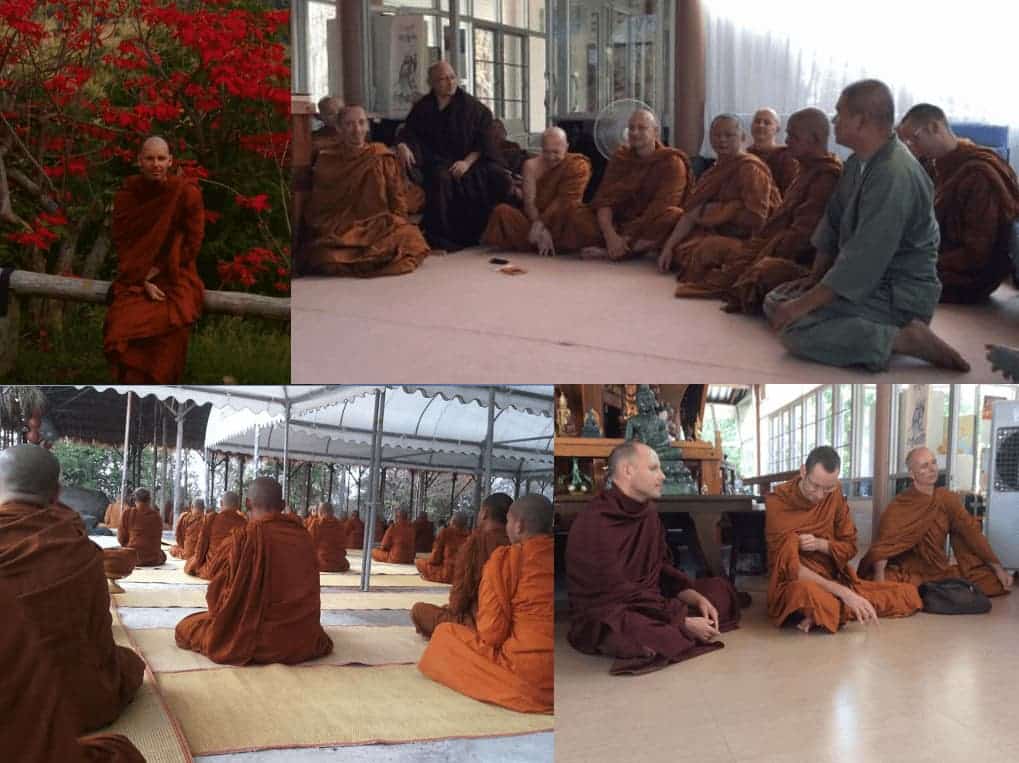
I went for a walk to explore the whole area. I had never seen such a large monastery with so many people, houses, cars, and even horses within a huge enclosed area. I met a monk who was walking and eating; anywhere else, that would have been a serious problem. Monks are not allowed to eat or drink while standing. When he saw me, he looked up at the sky, stretched out his arms, and said that he was free. I didn’t understand; it seemed very strange to me. I told him that I was looking for a kuti for myself. He was kind and walked with me around the place, showing me the surroundings.
I found one at the edge of a meadow near the forest; there were five of them in two rows—typical small kutis for monks. I moved in and got to know the monks in the area. I went to the other side of the monastery near the forest’s edge, where almost all the monks from Western countries lived. I met Jos, a monk from the Netherlands. He seemed very relaxed, sitting in a deck chair in front of his kuti, smoking and looking at nature. He was very thin, over two meters tall, and about my age. He had been a monk for ten years in the tradition of Ajahn Chah who was also a Buddhist monk with supernatural powers.
Jos had been here for a year and told me a little about the teaching in this place. He had no emotions or reactions, which is uncommon among monks; he spoke kindly and calmly, in a state of equanimity. In worldly life, it’s quite the opposite—people have strong thoughts, emotions, and reactions. If someone in the outside world would met such a person, they would say something is wrong with him, that he is a complete phlegmatic who cared about nothing.
Near him lived monk David from Italy and Jack from France. They had a pleasant environment of gardens and forest. For the first time in a year, I saw monks and nuns from Western countries in this place. There was also an older nun of the Tibetan tradition from the US and she spoke very highly of the teacher.
Daily Life and Atmosphere
Every morning, we went to a large open hall covered with a thatched roof. In front of the area with Buddha statues was a slightly raised platform on which the teacher sat. On his left and right sides sat the monks, and opposite them were the nuns and laypeople. First, we had a short main chant, then repeated after the monk a request for forgiveness, and sat in silence until the teacher arrived. Usually, he gave teachings with occasional pauses in silence, and sometimes we sat in silence the whole time.
A special energy was present. We sat with open eyes and in a relaxed posture. A few times, the teacher looked at me, and at that moment I felt a strong energy of emptiness in my mind and once a spiritual opening in my chest. I had experienced something similar before in Menga village.
After the sitting, we would take food and eat with the teacher in the open hall or anywhere else. Then we could spend the rest of the day as we wished. I met monk Lai, who had a nice kuti near mine. He always offered something to eat or drink—whatever he had. Monk Bond often came to visit him; he and I got along best—he was like a brother to me. He liked to joke, was always relaxed, and laughed a lot.
A few times, we went together to build new wooden huts for the monks. We rested in hammocks, which hung in almost every kuti. Wherever I went, people offered what they had and welcomed me with a smile. In the evenings, I went for a walk along the main road where others were also walking up and down. The sound of insects filled the air in a completely peaceful and freely pleasant atmosphere. Every day I read the request for forgiveness to cleanse karma— past inappropriate thoughts, words, and actions. Reading the request for forgiveness was a special practice of this teacher; it wasn’t found anywhere else that I would know.
Peculiar Teaching of Relaxation and Emptiness
Whenever tensions appeared in mind and body, we exhaled with the word “soooh” and slowly opened our hands apart. In this way, we released all tensions, sensations, and emotions from mind and body—without additional effort of meditation practice, but simply through relaxation. The mind opened in an instant and shone in emptiness. Instead of revolving in thoughts and emotions, we awakened out of them into pure awareness of the present moment. At the same time, it was the blessing of the power of emptiness, directly showing other beings how to free the mind. We did this at any time during the day.
Through the natural process, emotions and mental activity decreased, becoming increasingly subtle. I spent more and more time in emptiness—through relaxation and disinterest in mental activity, whether during actions or rest. It is precisely this disinterest or ignoring that removes the fuel from mental processes.
No Practice – The End of Desire
Meditation based on concentration is, in truth, another desire—the desire for better concentration in order to achieve something in the future. That is confinement within mind and body, instead of awakening from mind and body. The end of practice, the end of desire and effort—that is awakening in the present moment.
During morning sitting with the teacher and others, I sat in relaxation. Normally, one’s gaze is directing the energy of attention with slight effort outward through the eyes toward what is before us. I noticed that when I relaxed, this effort ceased, and the energy of attention that had previously flowed outward returned to its source. Then awareness opened. In complete rest, I perceived everything around me—there was only like a circle of awareness energy.
The Power of Emptiness and Spiritual Experiences
One sunny morning, shortly after breakfast, I was sitting in the emptiness of radiant awareness. In this pleasant state, I felt as if a strong energy had touched me. I looked at the teacher and saw that he had sent me the power of emptiness to see whether I could perceive it. From that day on a Buddhist monk with supernatural powers began teaching me directly every morning—transmitting the power of emptiness from mind to mind. That energy was so strong it brought about a deeper state of emptiness than ever before; thoughts lost their power for a longer time. Whenever a thought appeared later, the teacher would notice it and send me that power again. This energy was at least three times stronger than Samuki’s.
Over time, through experience, I realized that the expectation and desire for the empty state, as well as the desire to understand something in thought, prevent the empty state. I had partly experienced this already in prison during Zazen meditation, but then the mental activity would quickly return. Whenever in meditation we try to practice, understand, or achieve something, the mind and the desire for progress are always activated. That means orientation toward the future—and never the true ending of the mind here and now. Reading and thinking about how to understand it is yet another obstacle, as it remains within the field of mental activity.
One morning, I was in such a strong energy of emptiness that during breakfast adrenaline made me tremble. Later, these states became calmer, clearer, and awareness expanded. A few times I saw someone’s body tremble when they received the power of emptiness. The greater the power and the longer I stayed in that state, the deeper the experience became. Often, for an hour or two after morning sitting, I could not speak—I simply sat, looked at nature, and rested in deep peace and relaxation. I marveled at these special spiritual experiences.
Spiritual Insight and Transformation
One day, in emptiness, I realized that this was greater than all the states I had experienced in meditation during all previous retreats. I understood that even if I were to meditate alone in a cave my whole life following the old methods of strict renunciation, solitude, and practice, I would never be able to know and experience this. At that moment, the teacher looked at me and nodded. I realized that he knew exactly what was happening to me and what kind of thoughts I had.
The teacher could see into the spiritual realm and transmit the power of emptiness to different beings in the various realms of existence. They said that after his journeys, many spiritual beings—even enlightened ones—would return to the monastery with him, following his light of emptiness. He often took the monk David with him. I heard that in one of his previous lives, the teacher had been the fifth king of Thailand, while David had been a Russian king who helped him at that time. That was why they were still connected. There were many such stories.
Some people liked to visit often this Buddhist monk with supernatural powers, talk with him, and listen to his teachings; others simply sat near him because of the strong energy of emptiness. Because of his supernatural powers, many visitors came—bringing offerings of food and money—and some even moved there. Around him were monks he had chosen according to their shared past karma, who always stayed by his side.
Buddhist Monk with Supernatural Powers is a part of the chapter from my E-Book: Buddhist Monk Saved by Jesus. You can download it for free on my Home page ⟶ Buddhist Monk Saved by Jesus.
Continuation of the story and related topics
My experiences with the monk were just part of a larger spiritual journey. You can read more about what happened before and after this event here:
● Forest Meditation in Thailand – meditating in solitude in a forest and cave in Thailand.
👉 https://gospelgracegod.com/meditation-in-the-forest-in-thailand/
● Spiritual Experiences – Daily Experiences with Spiritual Beings
👉 https://gospelgracegod.com/spiritual-experiences/
If you want to understand how my story ended and who saved me from spiritual deception, I recommend reading my testimony:
● Buddhist Monk Saved by Jesus
👉 https://gospelgracegod.com/buddhist-monk-saved-by-jesus/
For a deeper understanding of the difference between Buddhism and the word of God:
● Jesus or Buddha – the Key Difference
👉 https://gospelgracegod.com/jesus-or-buddha/